Why a herbalist should know how herbs grow
For most of us, a herb is something that arrives already dried, in a jar or a paper bag, ready to be weighed out and used. We know it in its final form, as a tincture, a powder, or a dried leaf, and we rarely give much thought to the life it lived before it reached us. Yet every plant has a whole life before it becomes a remedy, and there is a strong case to be made that a herbalist ought to know that life intimately.
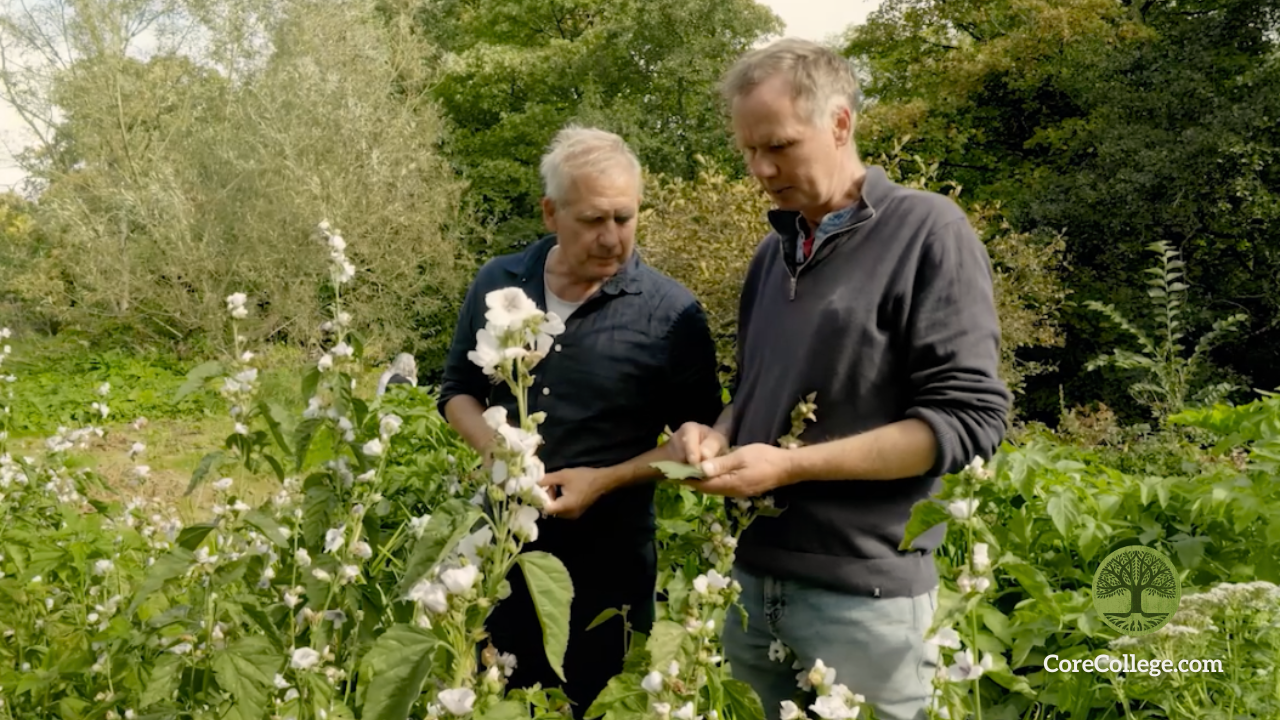
In the conversation above, Rachel Kelly, who tutors on our medicinal herb growing course, speaks with Professor Peter Jones, the course's scientist, and Klaus Laitenberger, our organic gardener, about why this knowledge matters so much, and why growing medicinal herbs is rarely a solitary undertaking.
Knowing the plant from seed to harvest
The heart of the matter, for Klaus, is that a herbalist should understand every stage of a herb's life, not merely the dried product at the end of it. He feels this strongly enough to believe it ought to be a requirement of the profession.
"A herbalist has to know the herbs," he says. "They need to know every stage of the growing of the herb, not just the end product, the dried product. It's absolutely crucial, really, and to see even from the life cycle of the seed germinating, or the plants being divided and growing to the harvestable product, is key to being a good herbalist."
There is real wisdom in this. A herbalist who has watched a plant germinate, grow, and come to harvest understands it in a way that no textbook or supplier's catalogue can convey. They know when it should be gathered, what it needs in order to thrive, how its character changes through the season, and what a healthy specimen looks and smells like. That knowledge feeds directly back into the quality of their practice. The herb in the jar is the end of a long story, and the herbalist who knows the whole story is the better practitioner for it.
You do not have to grow everything alone
A natural worry, for anyone considering growing their own herbs, is whether it is realistic to grow enough, and enough variety, on a small scale. Professor Peter Jones offers a reassuring answer, and it turns on cooperation rather than scale.
"Some growers would grow particular ones," he explains, "others would grow others that are particularly suitable to their own land site." Rather than each grower struggling to produce everything, growers can specialise in the herbs that suit their own ground, and share with one another. "Generally speaking," he adds, "growers are friendly people, and they will get to know each other, and if they're on the course together, they will work together."
This is one of the quieter benefits of learning alongside others. The people who train together form the beginnings of exactly these cooperative networks, each grower contributing what their own land does best, and the whole becoming far greater than any single plot could manage alone.
The passion that medicinal herbs inspire
There is something about medicinal plants that draws a particular kind of devotion. Klaus, who has been involved with the Core College garden since its earliest days, has noticed it plainly. "I've never seen so much passion and love poured into a place and into growing medicinal herbs," he says. "People seem to be much more passionate than with any other crop, because they have this affiliation with it."
It is not difficult to understand why. These are not ordinary crops. They are plants with a long human history of healing, and to grow them is to take part in that tradition directly.
What the practical training involves
The course is designed to give this full knowledge of the plant's life in a practical, hands-on way. Klaus, who leads the practical side, will be with students through the growing season, covering everything the work requires. "We'll go through everything that needs to be done during the season," he says. "You'll get a really deep insight into soil, into propagation, and also the little creatures that might invade our plants."
Soil, propagation, the rhythm of the seasons, the management of pests: this is the texture of real growing, learned by doing it.
To know a herb only as a dried ingredient is to know it in part. To have followed it from seed to harvest is to know it whole, and it is this completeness that makes a herbalist truly at home with the plants they use.
Learn more about the Diploma in Organic Medicinal Herb Growing →
This video is for educational purposes only and does not constitute medical advice; always consult a qualified healthcare professional before making changes to your health routine, especially if you are taking medication.